

Portraits with empathy
On portraiture, empathy, and the responsibility of seeing another person

I recently gave a talk at the WRYD retreat and felt I really wanted to share it here too
When was the last time you were photographed in a way that you felt loved or truly seen?
You know that feeling: the shock and warm glow of seeing yourself photographed in a way that you actually like.
Can you remember how you felt sitting in front of that camera?
Was it light-hearted?
Was it quiet?
Was it slow?
Or did it all happen quickly and naturally?
Do you remember who took that photograph?
And finally, an answer to keep to yourself and think through
If there was to be one lasting photograph of you, how would you want to be documented?
I am a millennial, steeped in the love of nostalgia, and that’s how I found myself drawn to film photography. My background is in architecture, and my career has spanned fashion, hospitality, lifestyle, and weddings. I photograph everything on 35mm or medium format film.
And today.. I wanted to talk about Portraits with Empathy.
It’s a practice I think I’ve considered from both being in front and behind of the camera a lot, but also, in the last 5 years of my career, beginning to photograph ‘normal’ people professionally.
When Luke (creator of WYRD) approached me to join the retreat, I knew the only topic I really had maybe some sway or knowledge to discuss was the desire to focus on lessening the ego of the photographer at a photographer’s retreat.
and remembering first and foremost, the human emotion and capacity for empathy.
Empathy (noun) is the ability to share another person's feelings and emotions as if they were your own.
As a deeply feeling individual, stepping into portraits, I actually began my own photography as a creative and artistic practice for myself
but soon I came to realise I feared being in front of the camera when it wasn’t a job.
I worried about being seen by not only myself but also others.
Who else also dreads seeing or having their photograph taken?
When you really ask yourself deeply, why is that?
Do you fear maybe seeing yourself through others’ eyes?
Or maybe it’s your insecurities that will be on show?
Do you worry about spiralling into discomfort?
Is it too affronting?
Or do you simply think you’re a better photographer? or that no one could possibly take a good photograph of you?
So what do you actually fear about being in front of the camera?
I think many people share in this anxiety, and yet as photographers we probably crave to document people honestly and hopefully with love in our work and our lives.
To be the keepers of history and archive the momentous times,
but also notice the incredibly quiet and sometimes insignificant moments,
because don’t we all believe that they are important?
I’ll tell you a little bit about the moment it hit me how important portraits and empathy became for me.
A few years ago, I was asked to speak on a panel at a show called “Analogue Spotlight". A popular analogue photographer conference-type event pulled together by labs, brands and small businesses.
It’s great really but I never usually attend these kinds of settings because of my fear of small talk but because I’d been invited to speak on a “women in film” panel, I thought - why not.
On that day, there was a variety of talks happening. People filled the rooms to the brim when Miles of Expired Film Club spoke, or Andy from Kodak, but there was one talk I was personally super excited to listen to.
It was called “Socially Engaged Art and Photography by Jagdish Patel. He is a UK-based researcher, artist, and photographer focusing on anti-racism, archives, and working-class communities, particularly in the Midlands.
As his talk began, the room emptied
And I sat there utterly baffled, a bit pissed off and stunned at the lack of desire to engage and listen to this talk.
Why on earth wouldn’t people who are photographers not want to listen to this?
To me, Mr Patel’s talk was life-changing to me.
He spoke about the historical use of photography in documenting war; he spoke about the responsibility photographers had; he talked through famous portraits and their impact on the subjects, and he spoke about how photographers need to let the participants in our art speak and how we need to listen to them.
He spoke about incredible people such as Norma McCovery of Jane Roe, Roe VS Wade and Du Bois, who was born in a Black Free community in the United States in 1868. He was a sociologist, historian, journalist, and anti-racist activist who wanted to challenge the image of the Black person as just ‘enslaved’ during a time when “human zoos” were common.
For the 1900 Paris International Exhibit, Du Bois planned and designed for months a display of hundreds of images, hand-drawn colourful infographics by his students charting the African American advancement, and some of the most beautiful, monochromatic photographs, taken by mostly anonymous photographers.
It confronted the myths, fear and hatred of Black people in Europe and North America.
This exhibit was historic. It was about challenging the entire system of racial representation that dominated international exhibitions.
Du Bois understood that empathy requires seeing people not just as individuals but as part of communities with shared experiences. Experiences everyone could relate to, labour, art, play, family. The portraits weren't isolated images but part of a larger narrative.
This work laid the groundwork for documentary photography as a tool for social justice.
Du Bois demonstrated how photography could be used not just to document reality but to shape public perception and build empathy and awareness.
I have the book and it’s something I encourage everyone to look through.
Du Bois created a space where his people could represent themselves. This shift from object to subject, from passive portrayal to active self-representation, is at the heart of empathetic portrait photography.
Mr Patel’s talk sticks with me today because he showed me the impact of not only named, but also unnamed photographers and more importantly, their subjects.
It instilled in me the passion to approach photographing people with consideration and a large amount of empathy.
It also taught me the huge impact our images can make on a person or a community’s history.
I want us photograpers to try and understand the balance of trying to create the beautiful artistic images we love, but also truly understanding the person in front of our lens.
I’m not asking everyone to become political radicals (or maybe I am)
but I am asking photographers to seek emotion and understanding with the task at hand.
So, how do you take portraits with empathy?
For me, I think it’s that awareness that is key.
Like a balancing scale, understanding the impact and importance of documenting, but being keenly aware of the human scene in front of you.
If I am documenting private individuals, I slide on the scale of trying to be invisible and present for them. Holding a comfortable and safe place to be.
Sometimes it was just about asking how they liked to be documented,
or how they were feeling that day,
Nothing beats a truly asked, “How are you doing?”
Sometimes there might be awkward moments. That’s normal. We all know how uncomfortable it can be to be in front of a camera. I’m pretty sure we’ve all been told hundreds of times - “I really hate having my photograph taken”
But conversation was important.
So what’s the opposite of empathy?
Unsympathetic? Ignorant? Their Focus is elsewhere. You tell me some examples.
Now imagine being sat in front of the camera, and someone is not really paying attention.
When I was younger, I used to model a bit. Whether I was booked for work or sat in front of friendly cameras wanting to be creative. One time, a photographer was photographing me, but not seeing me. He had some creative ideas and was a friendly enough person, yet I felt unseen.
It was as if he was just seeing a project or an item.
The photographer held all the power over my portrait. Where it was seen, how it was documented and how they edited it. It was true to their stylistic approach and their artistic desire.
He controlled the narrative.
We control the narrative, and I believe there is a responsibility to that.
How do you want to be perceived as a photographer by the people you photograph?
What is the lasting impression you want them to feel during their time sitting for you and afterwards?
Do you care?
In contrast, to give you another personal experience,
I attended a creative portrait film photography retreat in 2022. There was a group of 12-15 of us in a beautiful house in France run by these two female artists called Lena and Chantal. It is now called Closer Hearts
On the second day, I got so overwhelmed and self-conscious that I froze. I couldn’t take a single photograph. My anxiety was through the roof, and I struggled to know what I wanted to do. I wandered through the house and gardens, watching everyone run around, bubbling with creativity. By the evening, I was exhausted by my fear, and I asked to sit in one of the bedrooms where Chantal was taking photographs of a few others. The sun was low, pouring in gently, and she warmly welcomed me, embraced me, and I began to cry. In that vulnerable moment, she gently asked if she could take my photograph.
And I said yes.
She has never shared that photograph online, but she sent it to me. And it was actually quite beautiful.
And the photo is below
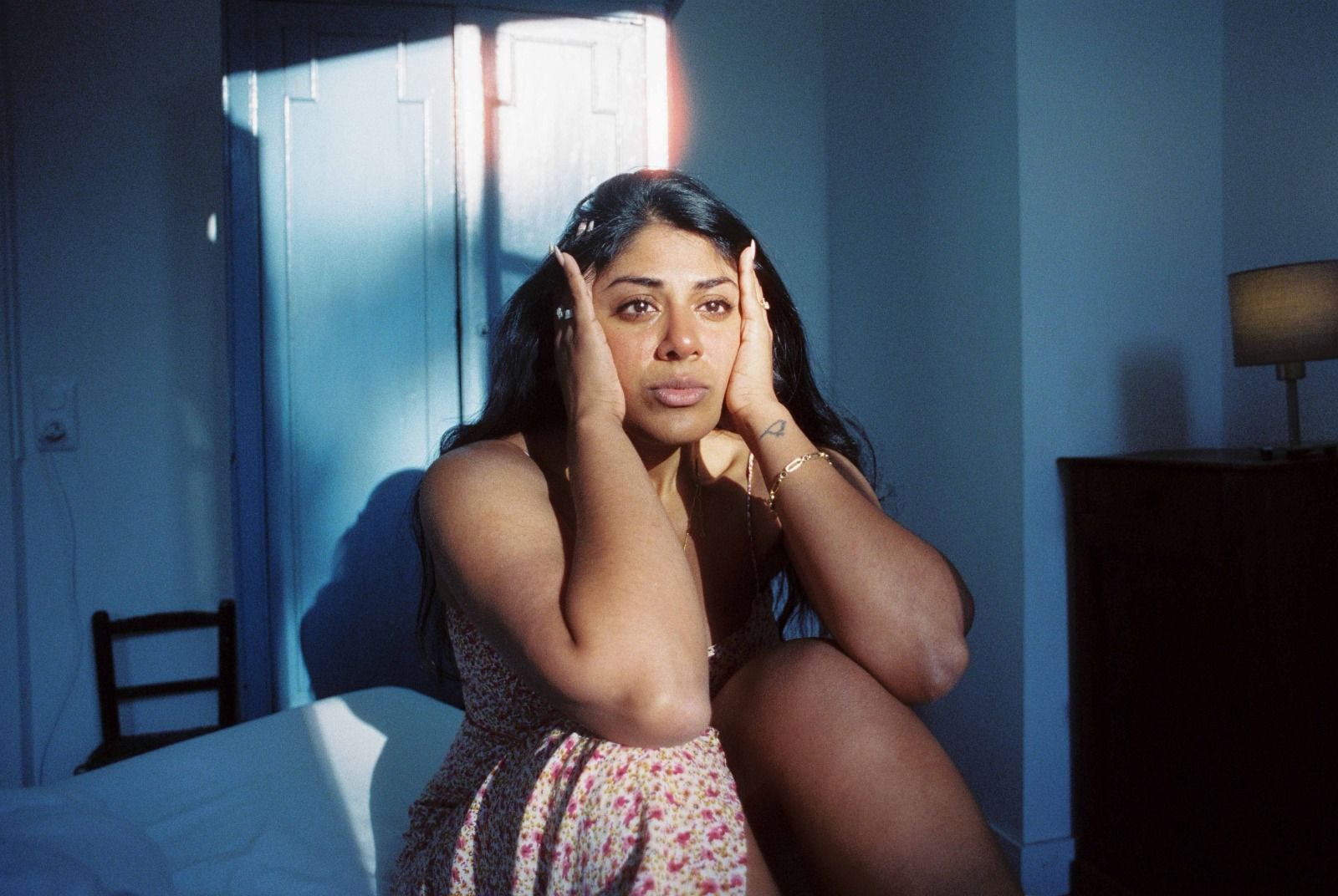
We’re not just photographers; we’re archivists of human experience
The conversations between us, the documenter and the subject, are important. The images we take become a part of that person’s history.
I often say to my couples when I’m on a call, and this is something I own as a badge of honour.
“In 20 years, you’ll probably forget my name or who I was, but the photographs I take, your photographs, will still exist.”
I want to circle back to one of my earlier questions.
If there was to be one lasting photograph of you, how would you want to be documented?
I’ll finish with this.
I don’t believe that every single portrait has been a success. I am acutely aware that there have been portraits of people I have documented that I know they don’t love.
You’re not always going to get it right, or you’ll take the photograph, and it doesn’t come out as flattering or artistic as you hoped, but that is just part and parcel of taking someone’s portraits and growing your skills
This is a practice I am continuing to work on and hope to get better & better
and honestly, I cannot teach you to have empathy or awareness when it comes to others in front of your lens; I can only encourage you.